How to Tell If a Competitor's Facebook Ad Is Working
You can't see a competitor's spend or return on ad spend, so you can't know for sure that an ad works. You can read public signals in the Meta Ad Library: how long it has run, how many versions of the idea the brand runs, how fast new versions appear, and whether the hook, offer and landing page stay put. When several of those point the same way, the ad is probably working.
Most tools answer "what ads exist?". The harder question is which ones the advertiser keeps paying for. What follows is the best public approximation, and where it can fool you.
Can you actually see if a competitor's ad is working?
No, not with numbers. Meta's Ad Library help page says ads about issues, elections or politics are shown with extra information, such as who funded the ad, a range of how much was spent and its reach, and that options differ in the EU and UK. For an ordinary commercial ad elsewhere there is no spend, no conversion count and no return on ad spend. Any tool that shows those figures is estimating.
So the question changes. You are looking for evidence that an advertiser keeps choosing to pay for something. Brands stop ads that lose money, so ideas that survive and multiply are the ones worth studying. That is an inference, and we label it as one.
How long has the ad been running?
Open any ad in the Meta Ad Library and you will see "Started running on" with a date. That is the first signal to read.
An ad that has run for 90 days has had 90 days to be switched off for losing money. An ad that started on Tuesday has not.
Longevity is a hint, not proof, for four reasons:
- The advertiser may have paused and relaunched the ad, or rebuilt it under a new Library ID, so the date can look newer than the idea.
- A cheap ad can run for a year on a tiny budget and look the same as an expensive one.
- Some ads are simply forgotten.
- Many brands now refresh creative often, so a long run is rarer than it used to be and, when you do see one, worth a closer look.
See our guide to finding the longest-running Facebook ads for more. Run time is where you start, not where you stop.
How many versions of the same idea does the brand run?
This is the signal people miss. Brands rarely run one copy of an ad they believe in. They run a handful or dozens of versions: a new headline, a different cut, another thumbnail, a different call to action.
In the Ad Library, look for the line that says how many ads use the same creative and text (it reads like "N ads use this creative and text"), and for ads marked as having multiple versions. The count shows how many ads share one idea.
Read it like this:
- One ad, no versions. Could be a test, an old leftover or a one-off.
- A handful of versions. The brand is trying audiences, placements or call-to-action buttons on the same idea.
- A large count that is still growing. The brand keeps adding to this idea. That is a stronger signal than any single ad's age.
Duplicates are not noise. They show where a brand puts its creative effort. Longevity plus duplication is the closest public proxy for a profitable ad, which is why we weigh the two together.
Check the number on two different days. A count that was 6 last week and is 14 today says more than a count of 14 you saw once.
How fast are they adding new versions?
Scaling shows up as speed. If a brand launched an idea three weeks ago and has already made ten versions of it, that is a different story from an idea with ten versions built up over a year.
Write down the Library ID and start date for each version, then look at the gaps. Several versions in a short window usually means the brand saw something work and moved fast to extend it. Evenly spaced versions over months usually means an always-on idea with steady refreshes.
You are reading effort, not budget. Nobody spends time making new versions of an idea they have given up on.
Does it run across placements and platforms?
Each ad in the library shows where it runs: Facebook, Instagram, Messenger, Audience Network, or a mix. A brand that runs one idea on Facebook and Instagram, in feed and stories, is putting it in front of more people than a brand that tried it in one place.
This signal is lighter than the others. Advertisers can leave placements on automatic, so wide placement can be a default rather than a decision. Treat it as supporting evidence.
Are they keeping the hook and offer and swapping only the visuals?
When a brand has a winner, it often keeps the part that works and changes the wrapper. Look across the versions of one idea and ask what stayed the same.
- Same first line, different footage. The hook is probably doing the work.
- Same offer, new faces. The offer is what the brand believes in. The creative is being refreshed to fight fatigue.
- Same video, new headline. They are testing the message on a proven creative.
Whatever stays fixed while everything else changes is the part of the ad the brand trusts. Whatever changes every week is what it is testing. That split is the most useful thing you can learn from a competitor's account, and it is more useful than knowing which single ad is "best".
Do the landing page and offer stay stable?
Click the call-to-action button and read where it goes. Then check again two weeks later.
A landing page that stays the same while the ads around it change is a good sign. So is a page written for the ad's exact promise. It usually means someone put work behind the idea.
An ad that sends people to a generic home page, or to an expired offer, is more likely a leftover than a bet. If the offer changes every few days, the brand is probably still looking for what converts.
What does not tell you anything?
Some things feel like evidence and are not.
Likes, comments and shares. Many ads in the library are dark posts, which means they run as ads without appearing on the Page's own feed. The engagement on a Page's regular posts says little about its paid ads. Even when an ad has comments, engagement is not sales. A funny ad can collect comments and lose money.
A single new ad. An ad that started yesterday has no track record.
Reach data from the EU. For ads delivered in the EU, Meta publishes extra transparency detail. It does not extend to commercial ads in other countries, so do not treat it as a general performance number.
How good the ad looks. Design quality is the weakest signal. A plain ad that has run for months tells you more than a polished one that started yesterday.
How do you check this by hand in 15 minutes?
You can do this with the Ad Library alone. Here is the routine for one competitor.
- Open the Ad Library at facebook.com/ads/library, pick the country your customers are in, and choose "All ads".
- Search the brand and pick the correct Page. Check the profile picture and follower count, because same-name Pages are common.
- Filter to active ads and note how many ads are live.
- Sort your attention by start date. Open the ads that started longest ago and write down each Library ID and "Started running on" date.
- Find the duplicates. For each long-runner, note the "N ads use this creative and text" count and look for other ads with the same hook.
- Group by idea. Put ads that share a promise, a hook or a visual into one row, count the versions, and note the dates of the newest ones.
- Click through to the landing page and write down the offer and headline.
- Write one sentence per brand: "They keep paying for ___, in ___ versions, since ___."
- Save the creatives and the date you checked. Stopped ads are hard to find again, and so is your evidence.
Repeat next week and compare. The difference between the two lists is the finding.
This works for one or two brands. At five, the spreadsheet starts to fail. For note structure, see our competitor ad analysis framework, and for the basics of searching, how to see your competitors' Facebook ads.
How does Seercraft do this automatically?
Competitor ad tracking reads each brand you add every day. It flags new and stopped ads and keeps the history after an ad leaves the Ad Library's active results, so the ad you wanted last month is still there. It groups copies of one creative into a single idea with a version count, so you see "one idea, 14 versions" rather than 14 near-identical ads.
Seer, the AI analyst, writes a short read of what each brand keeps paying for. You can also ask Seer questions about any tracked brand, in the app or from Claude, ChatGPT or Cursor over MCP. Every claim links to the ads behind it, and anything inferred is marked as inferred.
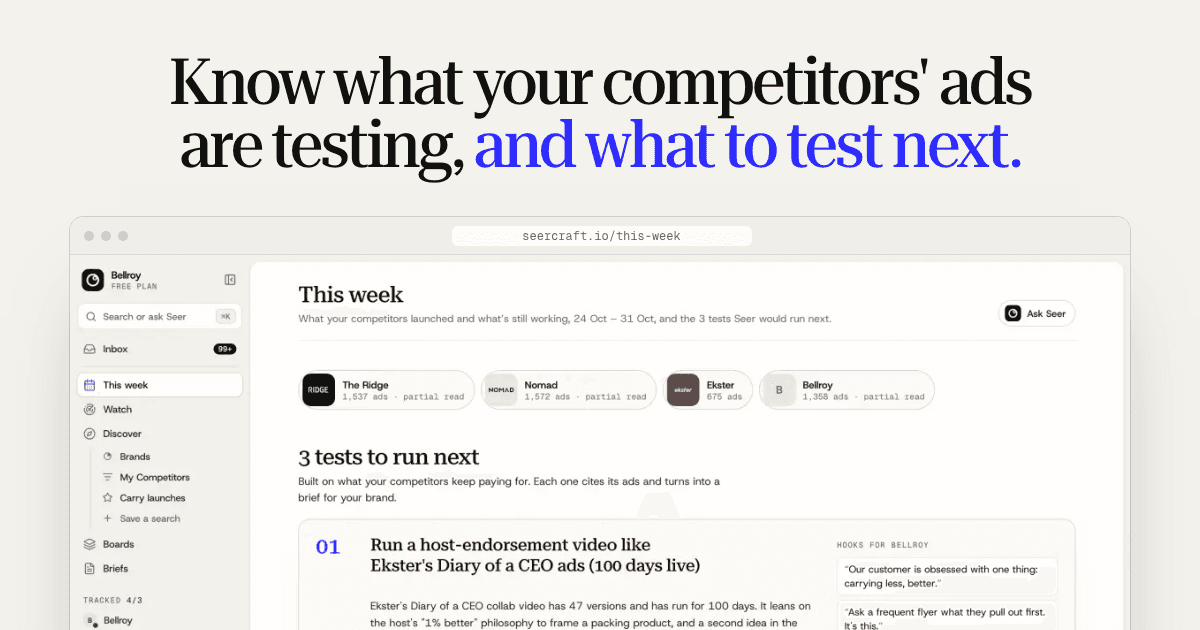
The weekly test plan (This week) then weighs how long ads have run and how many versions a brand made of them, and writes three tests for your brand, each with hooks and links to the competitor ads behind it. For a single ad, a breakdown reads the hook and the beats of the video, and a test can become a creative brief and a script.
Seercraft does not show competitor spend or ROAS. Nobody outside Meta can see them for commercial ads outside the EU, so it reads the same public signals you would, daily.
Sources
Checked 17 Nov 2026.
- What is the Meta Ad Library and how do I search it? (Meta Help Center)
- Meta Ad Library tools (Meta Transparency Center)
- Archived Ad reference, fields incl. ad_delivery_start_time (Meta for Developers)
- Meta Ad Library API: Ads Archive reference (Meta for Developers)
Add a competitor and start your free trial. Every subscription includes a 7-day free trial with a card required; see our pricing page for current plans and limits.