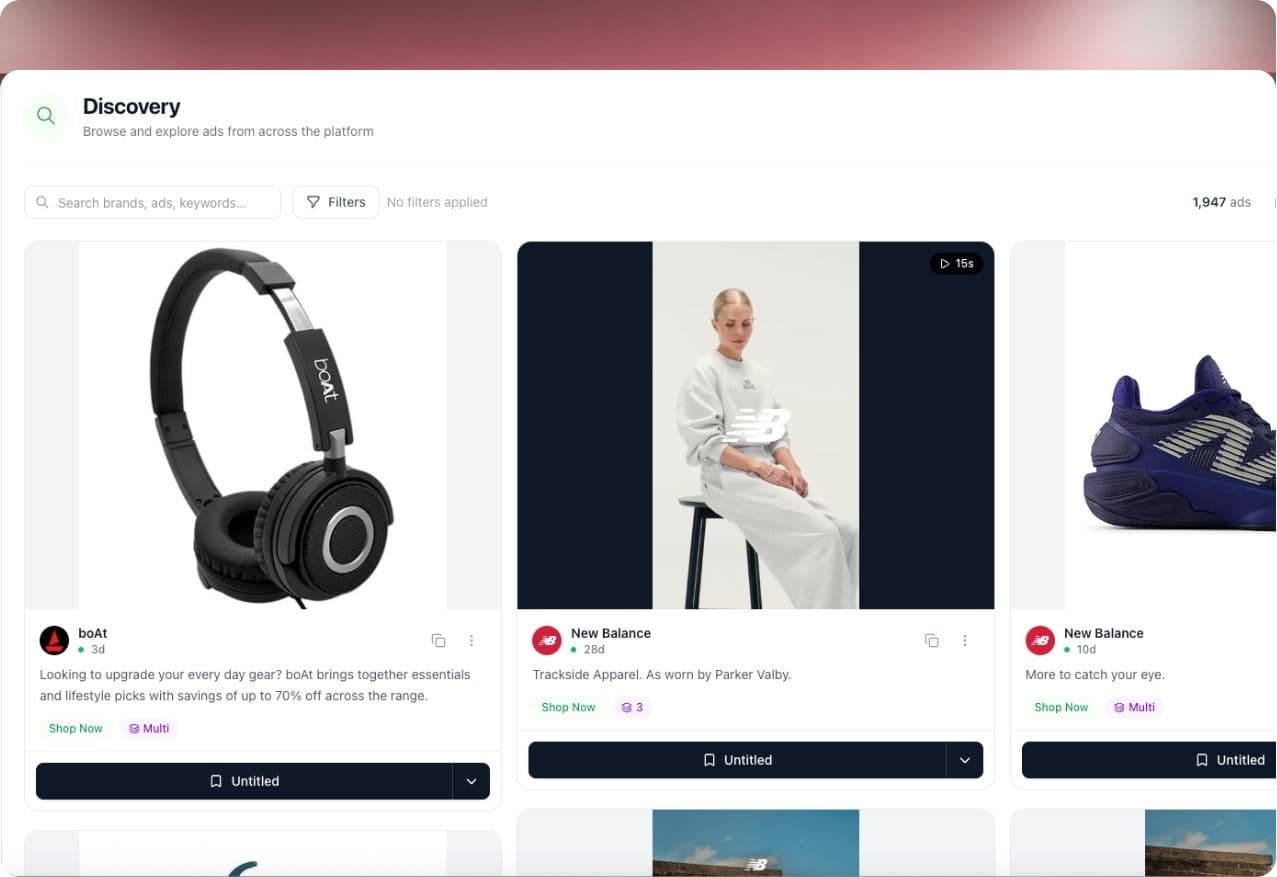
Ad Creative Intelligence: Why It Matters Now
You spend weeks brainstorming a campaign. You write the copy, design the visuals, pick the audience. You launch it. And within 48 hours, your competitor drops an ad with a nearly identical angle -except theirs converts better.
This is not bad luck. This is what happens when you make creative decisions in a vacuum.
The Problem Every Advertiser Knows But Rarely Solves
Here is something most performance marketers accept without questioning it: they are making million-dollar creative decisions based on what they think works, instead of what they can see working.
The Meta Ad Library is public. Every active ad from every brand is sitting right there. But have you actually used it? Searched a competitor, scrolled through 300 ads, tried to figure out which ones are new, which ones have been running for months, what messaging they are testing?
It is painful. The interface was not built for competitive research. It was built for transparency compliance. There is no filtering by format. No way to save ads. No way to compare. No historical data once an ad goes inactive.
So what do most teams do? They screenshot a few ads into a Slack channel, forget about them by Thursday, and go back to guessing.
What Ad Creative Intelligence Actually Is
Ad creative intelligence is not a fancy phrase for "looking at competitor ads." It is a systematic approach to extracting strategic value from the creative landscape around you.
Think of it in three layers:
Layer 1 -Collection. Getting access to the right ads at the right scale. Not 9 ads from a manual search. Thousands. Across brands, formats, regions, and time periods. The Meta Ad Library alone holds millions of active ads at any given moment. The question is whether you can actually access and organize that data.
Layer 2 -Analysis. Seeing patterns a human eye misses. Which hooks are your competitors repeating across campaigns? What visual formats are they doubling down on? Are they testing price-led messaging or benefit-led messaging? When you have hundreds of ads from a single brand, the strategy behind them becomes visible.
Layer 3 -Action. Turning those patterns into your own creative output. A swipe file is nice. An AI-generated brief based on proven competitor patterns -that is a competitive advantage.
Why This Matters More in 2026 Than It Did in 2023
Three things have changed.
Ad costs are up. CPMs on Meta have climbed steadily. When every impression costs more, the creative has to work harder. You cannot afford to test 20 mediocre concepts hoping one sticks. You need to start from a higher baseline -and that baseline comes from studying what already works.
Creative volume is up. The brands winning on Meta right now are not running 3 ads. They are running 30. Some are running 300. The sheer volume of creative being produced means the gap between teams that research systematically and teams that guess is widening every quarter.
AI has changed the production game, not the strategy game. Everyone can generate ad copy and visuals faster now. That is table stakes. What AI has not solved is the what to make problem. Knowing which concepts, hooks, and formats to produce -that still requires looking at the market. AI accelerated production but it did not replace intelligence.
A Concrete Example
Let us say you are a DTC skincare brand about to launch a new serum. Without creative intelligence, your process looks like this:
- Internal brainstorm with your creative team
- Come up with 5-10 ad concepts based on intuition
- Design, launch, test, iterate for 2-3 weeks
- Find a winner (hopefully)
With creative intelligence, the process shifts:
- Search for "skincare serum" across thousands of active Meta ads
- Filter by format (video, carousel, static) and by engagement signals
- See that 7 out of 10 top-performing DTC skincare ads in the last 90 days lead with before/after UGC in the first 3 seconds
- Notice that price anchoring ("was $89, now $39") appears in 60% of the high-runners
- Save the best 15 ads to a board, run AI analysis on common patterns
- Generate a creative brief grounded in actual market data
- Your designer starts from "here is what works and why" instead of "here is a blank canvas"
The difference is not subtle. One process produces creative rooted in hope. The other produces creative rooted in evidence.
The Data Problem Nobody Talks About
Here is the part most people skip over: getting the ad data is hard.
The Meta Ad Library is designed for browsing, not for analysis. Try to pull 500 ads from a brand programmatically and you will hit walls. The data is incomplete. Dates are imprecise. Ad copy gets truncated. Media files are not directly accessible.
This is why most teams give up on competitive research after a few manual sessions. The friction is too high for the output.
At Seercraft, we solved this at the infrastructure level. Our ad intelligence engine indexes over 2 million ads monthly with 99.9% data accuracy. Full ad copy, precise dates, direct media URLs, every platform and format. Three extraction layers ensure completeness even when primary methods are blocked.
This is not a feature. It is a foundation. Everything else -the search, the monitoring, the AI analysis, the brief generation -depends on having complete, accurate, structured ad data.
What Changes When You Have It
Teams that adopt creative intelligence consistently report three shifts:
Faster creative cycles. When your starting point is "here are 20 proven concepts in your category" instead of "what should we try?", the time from idea to launch compresses significantly.
Higher first-test hit rates. Your first batch of ads performs better because they are informed by market patterns, not guesswork. You still test and iterate -but your floor is higher.
Strategic confidence. You stop second-guessing your creative direction because you can see what the market is doing. You know when you are zig-ging while everyone else zags -and you know when that is intentional versus accidental.
Getting Started
If you are still making creative decisions without looking at what is working in your market, you are leaving performance on the table. That is not a sales pitch -it is math. The information is public. The only question is whether you are using it.
Start small. Pick your top 3 competitors. Look at what they have been running for the last 90 days. Save the ads that catch your eye. Look for patterns in hooks, formats, and messaging angles.
If you want to do this at scale -with AI-powered search, automated competitor monitoring, and brief generation -try Seercraft free for 7 days. No credit card required.
The brands that win on paid media in 2026 will not be the ones with the biggest budgets. They will be the ones with the best creative intelligence.