Giving Tuesday Ads: The Top One Isn't Asking for Money
The top Giving Tuesday ad on Meta in the US doesn't ask anyone to donate.
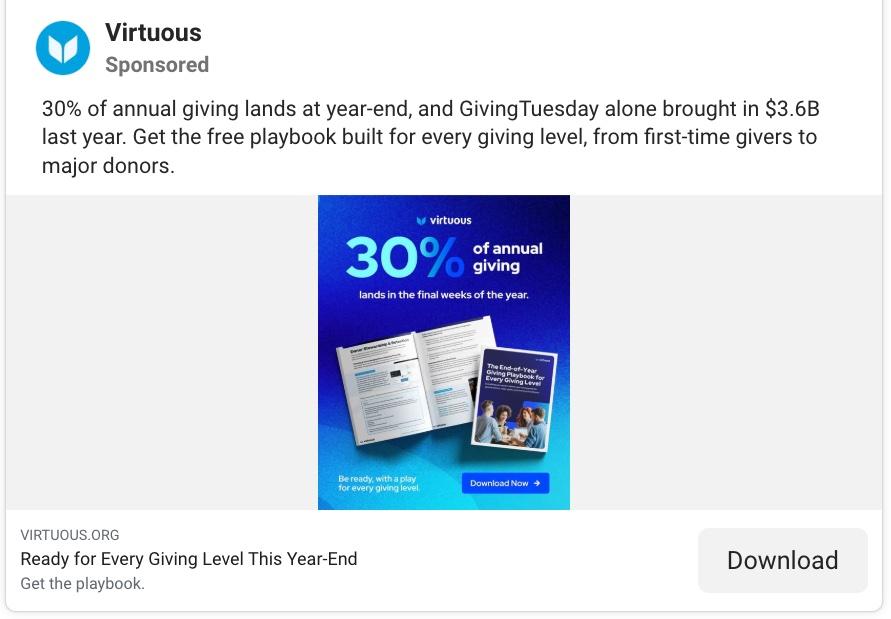
It's from Virtuous, a company that sells fundraising software, and it has run since 9 October:
"30% of annual giving lands at year-end, and GivingTuesday alone brought in $3.6B last year. Get the free playbook built for every giving level, from first-time givers to major donors."
The button says Download. The audience isn't donors. It's the charities that have to be ready on 1 December.
The short answer: Giving Tuesday is two markets. Nonprofits advertise to donors, and fundraising-software companies advertise to nonprofits. The second group has the top spot. If you sell to a business, your customer's biggest day is a deadline you don't have to invent.
What did we count?
We used the public Meta Ad Library's exact-phrase search for "giving tuesday", filtered to active ads in the US, sorted by impressions.
| Date read | Active US Meta ads saying "Giving Tuesday" |
|---|---|
| 12 November 2026 | about 1,200 |
| 23 November 2026 | about 4,100 |
| 24 November 2026 | about 5,700 |
Then we read the top results and removed duplicate versions of the same ad:
- On 24 November, 11 of the top 91 distinct creatives came from seven fundraising-software companies: Virtuous, Givebutter, Fundraise Up, Bloomerang, Zeffy, Neddie and Overflow. On 23 November it was 14 of the top 92.
- The #1 result on both days was the Virtuous ad. It's also #2 of the roughly 27 live US ads on Virtuous's own page.
- The rest are who you'd expect: Mercy Home for Boys & Girls, Dana-Farber Cancer Institute, World Vision, Save the Children, food banks, universities, and the GivingTuesday organization itself.
Which companies run Giving Tuesday ads to nonprofits?
The software ads split into two kinds: a free guide to download, or a product to sign up for.
Virtuous offers an end-of-year giving playbook. Its ad leads with a statistic about when donations arrive and asks for a download, not a demo.
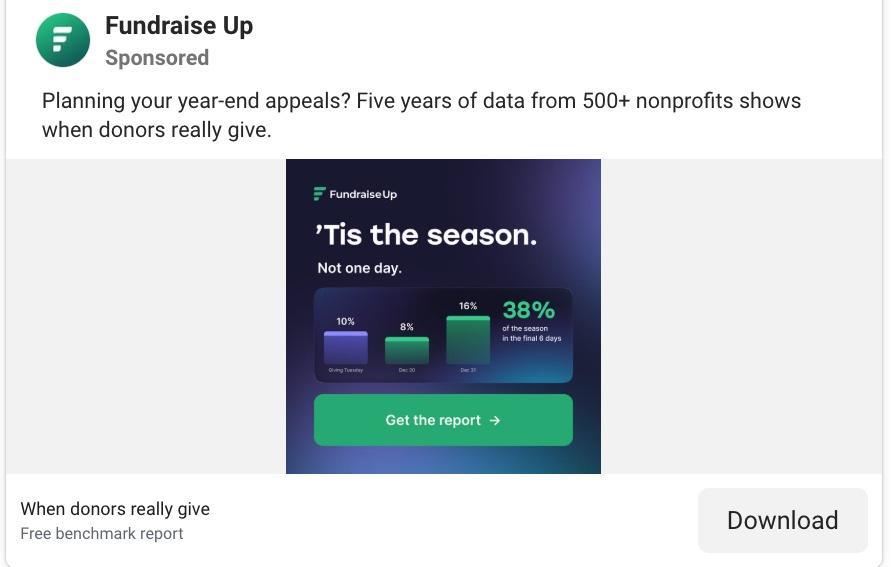
Fundraise Up offers a benchmark report. Its creative argues against the day itself: "'Tis the season. Not one day." The ad copy: "Planning your year-end appeals? Five years of data from 500+ nonprofits shows when donors really give."
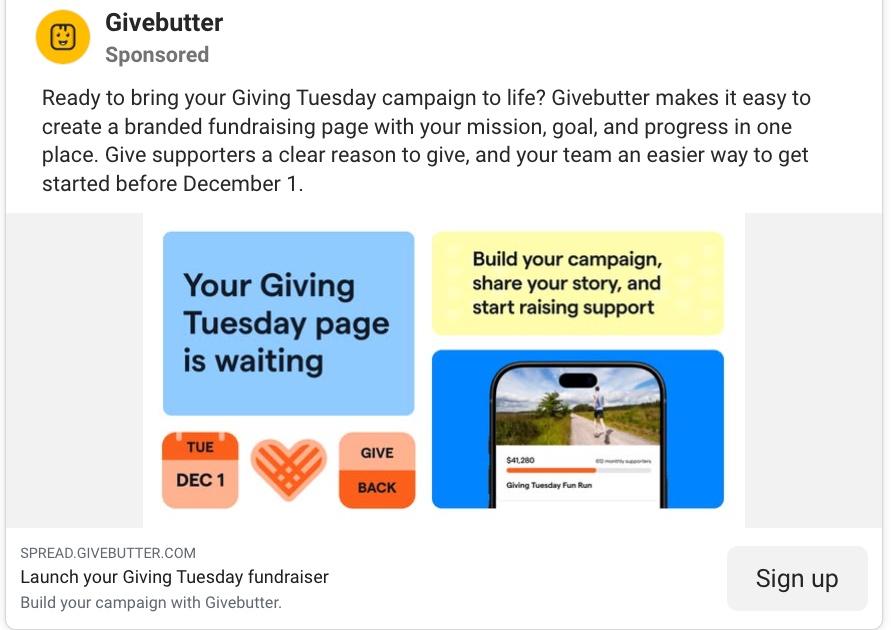
Givebutter sells the campaign page itself, with the deadline in the copy: "Give supporters a clear reason to give, and your team an easier way to get started before December 1." Its page had 8 of the top 111 results on 23 November, plus one more run through a creator's page.
The others:
- Bloomerang, 29 October: a "Giving Tuesday Ultimate Guide" on creating "branded content that cuts through the noise."
- Zeffy, 29 October: "Giving Tuesday is December 1, and year-end giving follows right after. Get your donation form ready now."
- Overflow, a giving platform for churches: "Year-end is the busiest season on the church calendar."
- Neddie, a fundraising platform, started its Giving Tuesday ads on 18 and 20 November.
The free guides started earliest: Virtuous on 9 October, Fundraise Up and Bloomerang on 29 October. The sign-up offers mostly came in November. A guide works while a nonprofit is still planning. A product works when the deadline is close enough to force a decision.
What can B2B marketers take from this?
- Put your customer's calendar next to yours. Giving Tuesday is a nonprofit's biggest day. For a fundraising-software company, it's the deadline that makes this the season to sell.
- Sell the prep, not the day. None of these ads sell anything for use on 1 December itself. They sell the guide, the form or the page a nonprofit needs before then.
- Start with a guide, then ask for the sign-up. Content offers went live in October. Product asks came closer to the date.
- Use the moment's name in the headline. "Your Giving Tuesday page is waiting" tells a nonprofit what the product is for before they read the copy.
- Name the deadline. Givebutter and Zeffy both write "December 1" into the ad.
Running time is a signal, not proof. Nothing in the library tells you which of these ads made money, and the $3.6B figure is Virtuous's own claim.
How do you find these ads for your own customers' moments?
- List your customer's big days. For nonprofits it's Giving Tuesday and year-end. For retailers it's Black Friday. For accountants it's tax day.
- Search the exact phrase in the Ad Library, filtered to active ads in your country, sorted by impressions.
- Skip the ads aimed at consumers and look for the ones aimed at businesses: guides, reports, demos and sign-ups.
- Note each ad's "Started running on" date. It tells you how far ahead of the day your competitors start.
- Count again a few days later. Our guide to searching the Facebook Ad Library covers the filters.
How does Seercraft help?
Seercraft is built around the public Meta Ad Library. Discover searches it and sorts results by how long ads have run. For brands you follow, Seercraft tracks them daily and keeps history after ads stop, so next year you can still see when a competitor's seasonal ads went live. Seer summarizes a brand's ads, and every claim links to the ads behind it.
We don't show spend, and nobody else can show it for commercial ads either.
Sources
- Meta Ad Library: active US ads containing the exact phrase "giving tuesday" (searches run 12, 23 and 24 Nov 2026)
- Meta Ad Library: Virtuous ad, Library ID 1730145444727374
- Meta Ad Library: Fundraise Up ad, Library ID 1475473584546099
- Meta Ad Library: Givebutter ad, Library ID 3754151078069243
- Meta Ad Library: Bloomerang ad, Library ID 1688934005979097
- Meta Ad Library: Zeffy ad, Library ID 1529410858945349
Add a competitor and start your free trial to see when their seasonal ads go live. Every subscription includes a 7-day free trial; see our pricing page for current plans and limits.