Foreplay vs Atria vs Motion (and Seercraft) in 2026
Pick Foreplay if you mainly need a big swipe file for a team, with competitor tracking on its higher plans. Pick Atria if you want one platform from research to generating and launching ads. Pick Motion if you spend well above $50k a month and want analytics and an AI analyst on your own ad account. Pick Seercraft if you mainly need competitor tracking that tells you what is working and what to test next.
We build Seercraft, so we are one of the options here and we have a stake in the answer. We have only used facts from the companies' own pages, with prices checked on 17 Nov 2026. Where we could not confirm something, we say so.
Are Foreplay, Atria and Motion the same kind of tool?
No, and this is the most useful thing to know before you compare prices. Each began as a different kind of product and still leans that way.
- Foreplay began as a swipe file. It saves ads from ad libraries so they do not disappear. Spyder, its competitor tracker, and Lens, its own-account analytics, were added later.
- Atria is a research and AI creative platform. It combines an ad library, competitor following, ad grading, image generation and launching to Meta, with an agent called Raya in front of it all.
- Motion is creative analytics for your own ad accounts. Its competitor research, called Inspo, is a smaller part of the product. Motion's Starter plan now includes Runneth, a dedicated AI analyst that also works in Slack.
So "Foreplay vs Atria vs Motion" is partly a question about which job you do. Saving and studying other people's ads is one job. Analysing your own ads is another. Making new ads is a third. Each tool does one of these best and the others to varying degrees.
How do they compare side by side?
Prices were checked on each vendor's own pricing page on 17 Nov 2026. Atria's prices were on a Black Friday and Cyber Monday sale at the time.
| Foreplay | Atria | Motion | Seercraft | |
|---|---|---|---|---|
| What it is for | Swipe file, competitor tracking, own-ad analytics | Research plus AI creative and launching | Analytics on your own ad accounts | Competitor tracking and test ideas |
| Competitor tracking | Spyder, Meta, on Workflow and up | Follow 50 brands on Core, 100 on Plus | Inspo, on every plan | Core feature, daily, Meta |
| Own-account analytics | Yes, Lens, on Workflow and up | Yes | Yes, the main product | Not yet |
| AI features | Script generator; connects to Claude and ChatGPT over MCP or API on Workflow and up | Raya agent on every plan; MCP and API calls capped by plan | Runneth AI analyst; briefs and reports requested from Slack | Seer analyst with cited answers, weekly tests, briefs, scripts; MCP for Claude, ChatGPT and Cursor |
| Platforms | Saves from Meta, TikTok, LinkedIn and more | Meta and TikTok | Own ad accounts | Meta today |
| Starting price | $49/mo billed annually, $59 monthly (Basic, no tracking) | $129/mo billed annually (Core, sale price; was $219) | $999/mo (Starter, up to $50k ad spend) | $49/mo monthly, $39 billed annually (Starter) |
| Free plan or trial | 7-day trial, card required | Free plan, no card | Pricing page links to a free trial; terms not stated | 7-day free trial, card required |
| Priced on ad spend? | No | Spend caps per plan | Yes, by spend tier | Never |
Atria also sells single-user Maker plans from $19 a month, aimed at individual creators rather than teams. Core is its first team plan.
What is Foreplay good at?
Foreplay is the widest save-anywhere swipe file of the three. It has a browser extension and a mobile app, and saved ads keep working after the advertiser stops them.
Spyder tracks competitor Meta ads daily and keeps their history. Lens connects your own accounts for creative analytics. Foreplay says there are no ad-spend limits or ad-spend pricing, which sets it apart from Motion. Workflow and above can connect Foreplay to Claude, ChatGPT and other AI tools over MCP or API.
The catches are about price and shape. Basic ($49 a month billed annually, $59 monthly) has no competitor tracking. Spyder and Lens start on Workflow, at $149 a month billed annually or $175 monthly, with 5 users. Agency is $389 a month billed annually or $459 monthly, with 10 users and 10 Lens brands. Extra users are $20 each. Foreplay ranks and surfaces ads, but we could not find a weekly "what to test next" output. The trial needs a card and bills when it ends, though the pricing page mentions a 14-day money-back guarantee after the first charge.
See our Foreplay comparison.
What is Atria good at?
Atria is the broadest tool here. One product covers an ad library, competitor following, ad grading, image generation and launching to Meta. Raya, its agent, is included on every plan, and the company says it also works in Slack. It covers TikTok as well as Meta.
The trade-offs are in how it is metered. Core is $129 a month billed annually (the sale price when we checked, down from $219), with 5 seats and 50 followed brands. Plus is $343 billed annually with 100 brands and Business is $959 with 200. Each team plan caps the ad spend it analyses: $500K on Core, $1M on Plus, unlimited on Business. AI work runs on credits, and bigger credit bundles cost extra. We did not see monthly prices for the team plans on the page.
If you want to go from inspiration to generated variants to a launched ad in one place, Atria is built for that. If you mainly want to watch competitors, you may be paying for a lot you will not use. On the other hand, it is the only one here with a free plan and no card.
See our Atria comparison.
What is Motion good at?
Motion has the deepest creative analytics for your own account. It auto-tags creatives, ranks your ads on leaderboards and builds reports. Runneth, its AI analyst, runs on its own dedicated machine and handles routines such as daily and weekly reports and alerts. You can ask for briefs, hooks and reports from Slack. Starter lists unlimited seats and unlimited ad accounts.
The price follows your ad spend. Starter is $999 a month for brands spending up to $50k a month. Pro covers spend above $50k and Growth above $125k, and neither shows a price. Motion's Runneth page says tiers are based on spend averaged over 12 months across connected accounts, which can push agencies pooling several clients into higher tiers. Competitor research (Inspo) is included but is a smaller part of the product.
If your problem is "which of our own ads are working and why", Motion is aimed squarely at that, and $999 is small next to a large media budget.
See our Motion comparison.
Where does Seercraft fit?
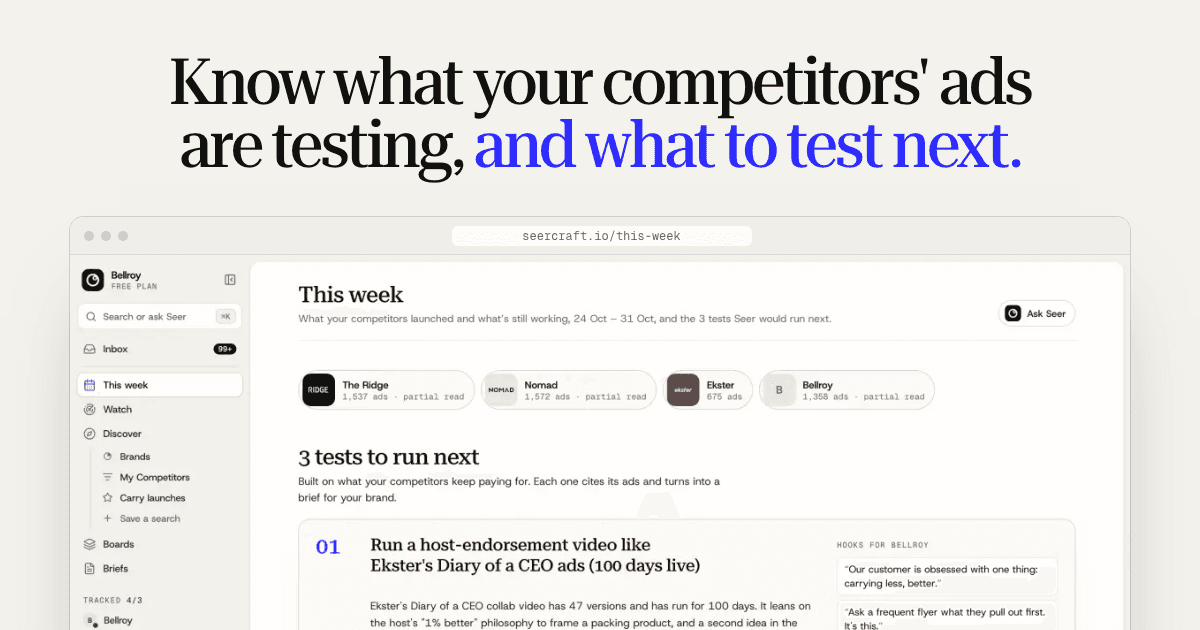
Seercraft does one job: it reads your competitors' ads. It tracks the brands you compete with in the public Meta Ad Library every day and keeps history after ads stop. It groups copies of one creative into an idea with a version count, so you can see what a brand keeps paying for.
Seer, the AI analyst, answers questions about any tracked brand, and every claim links to the ads behind it. Each week, This week gives you three tests to run next, built from what competitors keep running. Ad breakdowns read the hook and beats of a video ad, and a test or board can become a creative brief, a timed script and a teleprompter. You can also use Seer from Claude, ChatGPT or Cursor over MCP, and save ads from the Meta Ad Library with the Chrome extension.
Moving from Foreplay? On Pro and Agency you can paste your Foreplay API key and import your boards.
Here is what it does not do:
- Meta only today. TikTok, Google and LinkedIn are next, not live.
- No competitor spend or ROAS. Nobody outside Meta can see that for commercial ads outside the EU.
- No analysis of your own ad account yet. If you need that, Motion, Atria or Foreplay's Lens do it.
- No Slack yet. It is coming soon.
Plans are Starter ($49 a month, or $39 billed annually), Pro ($155, or $129 annually) and Agency ($389, or $319 annually), each with a 7-day free trial. None is priced on ad spend. See the pricing page for limits.
Can you use them together?
Yes, and many teams do, because the jobs barely overlap.
- Motion plus Seercraft. Motion shows how your own ads perform. Seercraft shows what competitors keep running and what to test. One looks inward, the other outward.
- Foreplay plus Seercraft. Foreplay holds the swipe file you curate by hand, across several platforms. Seercraft tracks the Meta competitors you care about and says what to try next.
- Atria on its own. Atria bundles research, analytics and generation, so some teams use it alone. The cost is that you pay for the whole bundle.
Two of these on one team is common. Three is usually overlap you are paying for twice. A fair test is to add one real competitor to two tools and compare what each tells you in an hour.
Which should a creative strategist pick?
Match the tool to the situation, not to the longest feature list.
- You run a small team and need to save and share ads. Foreplay. A swipe file is its core, and Basic is the cheapest way in. Plan on Workflow if you also want competitor tracking.
- You want research, generation and launching in one tool. Atria, if the credit and spend caps fit your budget.
- You spend heavily and want to know why your own ads win. Motion. It is built for your own performance data and priced for larger budgets.
- You mainly watch competitors and need to decide what to test. Seercraft. It starts from competitor ads and ends at a weekly list of tests, with the ads cited.
- You spend very little and just need a look today. The free Meta Ad Library may be enough, though it forgets most stopped ads.
If you cannot decide, ask what you do on a Monday morning. If it is "look at what competitors launched", you need a tracker. If it is "check how our ads did", you need analytics. If it is "make more ads", you need a creative tool. Pick the tool for that job first, and add a second only when a real gap shows up.
For a wider list, see our guide to the best competitor ad tracking tools, and if you came from MagicBrief, read MagicBrief shut down: what to do now.
Sources
All checked 17 Nov 2026.
- Foreplay pricing
- Foreplay help: Track a competitor with Spyder
- Atria pricing
- Motion pricing and Runneth pricing
- Seercraft pricing
Add a competitor and start your free trial. Every subscription includes a 7-day free trial, and a card is required.